


4th annual gourd dance held at Camp Navajo
By Anne Griffis
Special to the Times
BELLEMONT, Ariz., June 28, 2012



(Special to the Times - Leigh T. Jimmie)
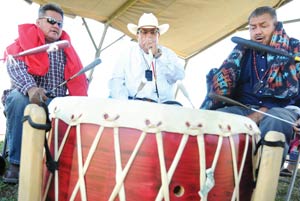
TOP: David Clark, of Teesto, Ariz., conducts a prayer with smoke and eagle feathers in honor of the 3rd annual Army National Guard Gourd Dance at Camp Navajo Depot in Bellemont, Ariz., on Saturday, June 23. <br><br>SECOND FROM TOP: Members of southern host drum Long Walk Descendants, from Blue Water, N.M., include, left to right, Rudy Coan, Ramone Yazzie Sr. and Michael Coan. They are singing an honor song at the 3rd annual Army National Guard Gourd Dance at Camp Navajo Depot in Bellemont, Ariz., on Saturday, June 23. <br><br>THIRD FROM TOP: Family and friends show respect and honor for gourd dancers at the 3rd annual Army National Guard Gourd Dance at Camp Navajo Depot in Bellemont, Ariz., on Saturday, June 23. <br><br>Fourth from top: Geraldine and David Clark, from Teesto, Ariz., attend the 3rd annual Army National Guard Gourd Dance at Camp Navajo Depot in Bellemont, Ariz., on Saturday, June 23. <br><br>FIFTH FROM TOP: A yellow ribbon hangs from a tree at the entrance to Camp Navajo Depot in Bellemont, Ariz., on Saturday, June 23.
T he Arizona Army National Guard held its fourth annual gourd dance at Camp Navajo on Saturday, June 23.
The purpose of the dance is to pray for all who have served in the armed forces, honor the warriors who never came back, heal those who were wounded, and restore wholeness to those suffering from post-war trauma.
"The gourd dance is a different approach that we have not taken in the past, to welcome home our returning veterans and honor the wholeness of our soldiers," said Maj. Mark Railey, Headquarters Detachment for Garrison Command, who received an award from the gourd dance society for his support of the event.
This week, six to eight Army National Guard members from Camp Navajo were deployed to Afghanistan with the 258th Engineers.
"We are in a rich position to show recognition of the significant contributions of the Navajo and Hopi nations, both now and in the past, to this installation and to the nation," said garrison commander Lt. Col. Dale Oldham.
Family histories
Col. Adrian Nagel was commander when former guardsman Freddy Etsitty urged him to tour a place called Indian Village about six miles west of Camp Navajo. Navajo and Hopi families, who had worked as ammunition handlers during World War II, had lived there in hogans and tents.
Etsitty showed Nagel what was left of a tree house, footings and a girlfriend's name carved into a tree that marked the place where he lived when he was a child.
Nagel's own family history is entwined with Camp Navajo's. His maternal grandfather, who was a sheepherder living near the site in the 1940s, helped build the installation.
Nagel approached the secretary of the Army for cultural resource management, and had a survey of the site done. Camp Navajo won first place for cultural resource management in 2008 and began the tradition of the annual gourd dance.
The gourd dance society on Saturday called Nagel into the circle and gave him a blessing. Nagel now serves as active Guard reservist for the Department of Defense at the Pentagon in Washington, D.C.
A flagpole at the eastern part of the dance circle blew over and the American flag dropped to the ground.
"When an eagle feather touches mother earth, it means that a comrade or veteran has passed on, and we have a certain way of taking care of things," explained head gourd dancer Larry Anderson. "This flag has told us in a true way, what some of us were told earlier this morning, that one of our code talkers, Frank Chee Willeto, has passed away."
'Part of the military'
The gourd dance, which is said to have originated with a Kiowa men's warrior society, incorporates rattles often made of gourds and a red and blue sash.
Gourd dancer David Clark and his wife, Jeri, were among the first Native Americans to secure work at Camp Navajo during World War II. Jeri Clark's brothers, Freddy and Larry Etsitty, were initiated into the gourd dance society on Saturday.
Jeri Clark reminisced about her childhood at Camp Navajo.
"My parents were ammunition handlers," she said. "There were three shifts, and the military was short on people so they hired workers from the reservations. Dad would come home after an eight-hour shift and then Mom would go to work. That's when a lot of women started to wear jeans.
"Most of the people were non-English speaking and very traditional," she continued. "They caught on quickly. They always felt they were part of the military. That's what they were told and that's what they believed."
The Clarks' families joined the Native American Church while working at Camp Navajo and risked their livelihoods by using peyote during their religious ceremonies.
"They were praying for peace. And because they were handling bombs and ammunition, they were praying that this would be a safe place to work," Jeri Clark explained.
A dislike for peyote
David Clark continued, "The majority of people in the camp didn't like the NAC because it was not Navajo. It originated in the southern plains with the Kiowa and Comanche tribes. They said peyote was a drug that was not good to consume, that would make you crazy."
Although David Clark was just a boy at the time, his family's involvement with the NAC led to his being harassed by his peers.
"There is a story that the Holy People placed peyote here among the medicines for Navajos to use," mused Clark.
A Navajo committee told the commander of their objection to peyote. The commander had the hogans of NAC members searched and the men brought to his office for questioning.
David and Jeri Clark's fathers were among those who were warned by the commander that if they did not discontinue the use of peyote, they would lose their jobs and be evicted from the camp.
"It was our way of life. The medicine was already in us. How were they going to take it out of us?" David Clark said.
In the 1940s the Navajo Tribal Council voted 53-1 to ban peyote, with Hola Tso of Sawmill, Ariz., dissenting.
According to Clark, the church went underground until the 1960s when the use of peyote was re-introduced as a civil right, protected by the first and 14th amendments of the U.S. Constitution.
A change in politics, laws
In 1966, the NAC joined with a group called the Navajo Rights Organization to campaign for Raymond Nakai, who won the chairmanship.
Nakai's platform included the establishment of a constitution and bill of rights for the Navajo Tribe. The bill of rights protects the free exercise of religion.
As a result of favorable court decisions over the years, Arizona state and federal laws no longer prohibit the use of peyote by members of the NAC for sacramental purposes.
The gourd dance at Camp Navajo was held outdoors and included non-members of the NAC church. Arizona Army National Guard Master Sgt. Freddie Hatathlie, of Coalmine, Ariz., organized the event.
Dennis Bedonie, a youth counselor in the Tuba City Unified School District, who grew up in Bellemont, was master of ceremonies. Descendants of the Long Walk, of Gallup, served as host southern drum.
Oldham said, "The tradition of the gourd dance is to welcome home and pay tribute to our warriors, and to give closure to the military engagement they've had."