


Popular puppets
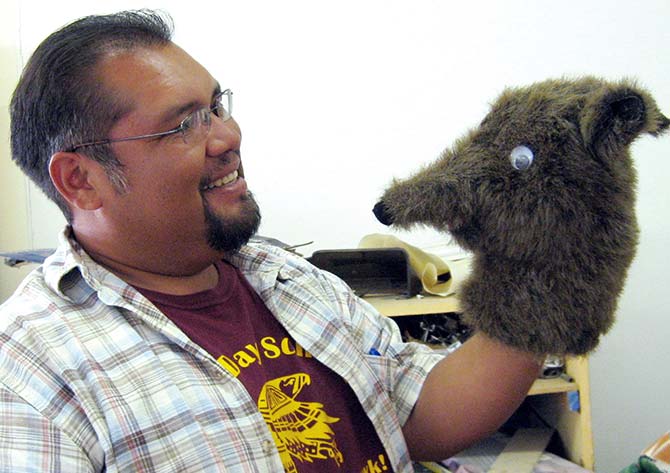
(Times photo - Cindy Yurth)
Leon Fred, artistic director for Three Mesas Productions, converses with Iisaw (Coyote), a central figure in many Hopi stories.
No dummies, these dolls make darned good teachers
By Cindy Yurth
Tséyi' Bureau
BACAVI, Ariz., July 8, 2010
A summer program on Hopi allows local children who are still learning themselves to share their culture and language, while also absorbing acting, singing and confidence-building skills.
Three Mesa Productions, now in its third year, last week mounted a series of performances on and off the reservation to wide acclaim. The show uses both live actors and puppets to tell traditional Hopi stories in a mixture of Hopi and English.
"Our mission statement is 'Preserving language through the performing arts,'" said Three Mesas founder Leslie Robledo. "People have tried to get us into drug prevention, diabetes education, all kinds of things. But I feel strongly that we need to keep our focus."
Besides, she said, if you really listen to the Hopi stories, you'll hear messages of being a responsible, spiritually focused person, which should help you fend off life's bad choices.
Robledo founded Three Mesas in 2007 after graduating from the Hopi Foundation's Hopi Leadership Program.
"We were supposed to start something in the community after we graduated, so this was my project," she explained.
Initially Robledo grappled for a goal she could be passionate enough about to follow through.
As a mom, she was concerned that younger people weren't hearing the Hopi stories she enjoyed so much from her own childhood. But she wanted a way to teach them that would be so much fun, the kids would seek them out.
For some reason, she flashed back to the third grade.
"We did a puppet show," she said. "It was the only time in my life I was ever involved with puppets, but it was one of the funnest things I ever did in school."
Unfortunately, Robledo had no acting skills, no theater production skills, and wasn't even fluent in Hopi.
"Luckily, I ran into Leon," she said.
That would be Leon Fred, a Hopi who had recently returned to Bacavi with a theater arts degree, graduate credits in voice, and a wealth of community theater experience. Unfortunately, he wasn't fluent in his tribal language either.
"We pretty much had to learn alongside the kids," Fred said.
They sought out advisers from their tribe's Cultural Preservation Office and developed simple scripts, in a combination of Hopi and English, based on the stories Robledo had heard in her youth.
Robledo's husband, Donovan, designed the sets, sound and lighting. Local children were recruited to operate the puppets - which incidentally involved memorizing dozens of lines in Hopi.
Fred taught them how to get into character, project their voices and keep on pitch when they sang the traditional songs that are part of the stories.
"It started out as a one-time deal," Fred said. "But people liked it so much, we decided to keep going."
The community pitched in. Talented seamstresses stepped forward to convert the troupe's original crude sock puppets into charming characters.
Bacavi Village offered the abandoned community warehouse for rehearsals, the use of a van to transport the troupe to gigs, and money for gas. Local merchants chipped in food and beverages for long rehearsals. The venerable Hopi Foundation took the fledgling program under its wing.
This year, Three Mesas partnered with Tutuqaiki, the Hopi school, to offer a simple acting and voice class. Four of the students volunteered to act in this year's Three Mesas shows.
The reason for all the enthusiasm is that Three Mesas' productions don't only appeal to children, theorizes Marvin Allison, Robledo's brother and an artist who helps out with set painting.
"Leon and Leslie designed the shows for kids," said Allison. "But it's the elders who really enjoy them. Every time we perform, some of them get tears in their eyes."
Last summer the productions hit a snag when Donovan Robledo died of a chronic illness just before the first show was to open.
"We didn't do much after that happened," Fred said.
This year, Bar Lehmann, an intern with the Hopi Foundation, stepped in to offer technical assistance. But Leslie admits she had trouble getting motivated without her soulmate and main support.
"It would take three or four people to take Donny's place," she said, tearing up as she looked at photographs of her husband with the troupe.
Still, the show must go on, and it is. And Leslie Robledo is slowly stepping back into her role as visionary. Once she starts talking about Three Mesas, the ideas gush out as though the three mesas were three volcanoes.
"I'd love to buy the warehouse and convert it for our purposes," she said. "Eventually, I'd love for Bacavi or one of the villages to have a nice community theater where we could host concerts and poetry slams as well as the puppet shows.
"We need to get independent and form our own 501(c)3 (nonprofit corporation). I need someone who knows how to do that. We need office supplies. We need an old travel trailer that we could keep all our equipment in and drive around to performances ..."
It's evident that Three Mesas, like its puppets on its best nights, has taken on a life of its own.
To volunteer or for more information, call Robledo at 928-734-9489.
 E-mail this story