


Battle for sacred mountains
Tribes win say in future Tsoodzil developments
By Chee Brossy
Navajo Times
WINDOW ROCK, June 11, 2009
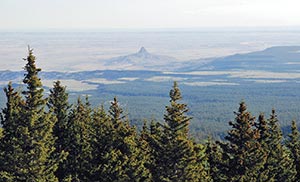
(Special to the Times - Donovan Quintero)
This view shows the northeast portion of the Eastern Agency from atop Tsoodzil on May 3. Area tribes can claim a victory after the New Mexico Cultural Properties Review Committee declared the mountain a traditional cultural property.
Native American tribes won a small victory June 5 when the state of New Mexico designated Mount Taylor - Tsoodzil to Navajos - as a "traditional cultural property."
The designation provides five tribes with a say in future developments that may take place on the mountain, the southernmost of the Navajos' four sacred mountains.
The Navajo Nation joined with the Hopi Tribe and the pueblos of Acoma, Laguna, and Zuni in nominating Mount Taylor as a traditional cultural property.
The designation covers an area of 434,767 acres, but within the boundary are 89,938 acres of private lands, which are not part of the designation. The majority of land in the Mount Taylor designated area is federal or state land.
It was from the owners of these private lands that the tribes had the most opposition.
The TCP designation, made by the state's Cultural Properties Review Committee, will require state agencies to consult with tribes over developments on the mountain that require state approval. It also makes the property eligible for listing on the National Registry of Historic Places, although there are currently no plans to pursue federal listing.
The listing changes the process for mining permits on Mount Taylor, requiring applicants to get a regular permit for exploration, rather than a minimal one, said Catherine Slick, director of New Mexico's Historic Preservation Division.
"There is confusion that (the TCP listing) will deny mining," she said. "It doesn't do that, but it opens it up to consultation."
Vice President Ben Shelley attended the Cultural Properties Review Committee meeting June 5 in Santa Fe. Shelley also attended a number of public hearings, including one a year ago in Grants, and another on May 15 in Santa Fe, where he said, "We were slandered with words from the landowners."
The May 15 public comment session was held in Santa Fe following a request by the tribes to hold the hearing at a neutral site, Shelley said.
"(Mount Taylor) is a holy place for the Navajo," said Shelley in a June 8 interview. "The animals, the trees, the birds, they're sacred to us. It's where the stones are collected for the ceremonial mountain bundles that are used in Hózhóójí."
"It's where the medicine man goes," he said. "It's where a lot of people go to get what they want for ceremonies. It's very sacred to Navajos, and it's the same way with the Lagunas and the other pueblos, too."
Mike Bowen, executive director of the New Mexico Mining Association, was unhappy with the designation.
"Of course we were disappointed with the decision," he said. "I think it's intended to stop uranium mining on Mount Taylor. But we'll jump through whatever hoops we're required to."
When the mountain was granted provisional protection several months ago, both the mining industry and many residents of the area's largest town, Grants, were irate.
They accused the tribes of attempting a land grab and claimed the commission had acted without notifying the public.
The commission announced that under the law it was required to hold public hearings before making a decision.
Theresa Pasqual, director of Acoma Pueblo's Historic Preservation Office, acknowledged that the majority of development on Mount Taylor has to do with mining, and said the intention of the tribes is not to stop mining.
"The TCP is a tool that serves as a guide," Pasqual said. "The tribes have basically said they want a seat at the table when development is proposed."
Pasqual added that places of cultural significance to tribes on the mountain are only identified in archeological surveys - when development is about to occur, not before.
So included in the TCP nomination was identification of 316,456 "contributing resources," or places and things of importance to tribes, such as pilgrimage trails, shrines, plants, animals, buildings, burial sites, and petroglyphs on the mountain.
Pasqual termed this new approach to identifying things of cultural importance as "proactive rather than reactive."
But some, including locals who hope for uranium jobs and landowners whose property falls within the TCP boundary, oppose the decision.
Although the private land is "non contributing" to the TCP and therefore does not receive the same treatment, some fear it will be subject to the same restrictions on development.
There has been talk among property owners of a lawsuit to reverse the TCP designation.
The disagreements between the tribes and opponents of TCP designation often created tension at the public hearings and June 5 commission meeting, said Robert Tohe of the Sierra Club, who attended them all.
"Prior to this vote there was a lot of divisiveness and veiled threats on what would happen if Mount Taylor was designated as a TCP," Tohe said in a phone interview. "You would hear people from the Grants area express that sentiment towards the tribes.
"But they never addressed the application (for TCP) itself," he said. "There is every justification to have that as a traditional cultural property."
SIDEBAR: Tsoodzil looms large in Prewitt hearts, landscape »
NEXT: High court refuses to hear Dook'o'oosliid case »
 E-mail this story