


Learning to like the Diné song & dance
By Cindy Yurth
Tséyi' Bureau
GALLUP, Aug. 20, 2010
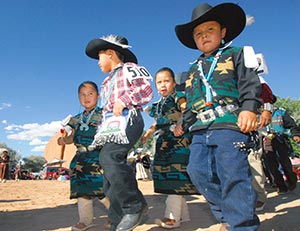
(Special to the Times - Donovan Quintero)
Dancers from the Canoncito Moonlight Chanters, including, from left, Kerah Monte, 3, KeShawn Cabaza, 5, Kylie Monte, 5, and Kyle Monte, 5, perform the song and dance Aug. 14 at the 89th Annual Inter-Tribal Indian Ceremonial at Red Rock State Park in Church Rock, N.M.
In my five years in Chinle, I've been to quite a few of them, and they always just looked like overdressed people plodding around in a circle.
While covering the Inter-Tribal Indian Ceremonial in Gallup last weekend, I knew I should at least show up at the song and dance, one of the few truly Navajo events at the annual festival.
Compared to the powwow, which was housed in a huge lighted tent with hundreds of spectators, the song and dance looked like a lost stepchild. There were small canopies for those watching, but no shade for the mostly elderly dancers, who soldiered on in their long-sleeved velvet shirts in the 90-degree heat.
The powwow had attracted quite a few white tourists with video cameras, but at the song and dance, the handful of spectators all looked Diné.
I chanced upon Rydell Freeland, a 20-something acquaintance from Chinle. Rydell usually dresses like a modern young professional, unless he's picking up wind-blown garbage in his grubbies with his Chinle Against Trash committee. I almost didn't recognize him in a cowboy hat and button-down Western shirt.
Rydell was with his elderly grandparents, who I assumed had dragged him to the event. Not so: He had dragged them. His chei hadn't been to a Ceremonial since 1954.
Now, I could see how older folks could get into the slow, methodical rhythm of the song and dance, but I was incredulous that a young, hip Navajo like Rydell could like it. I decided to just admit I didn't "get" the song and dance and see if I could at least get an education.
"What on earth is the appeal of this thing?" I asked Rydell.
To Rydell, the song and dance is a chance "to be a real Navajo."
He explained that it is descended from the social dance of the Enemy Way ceremony, and traditionally was the only opportunity men and women had to dance together - in fact, it was the pretty much the only time Navajos danced at all.
"If you listen to the lyrics of the songs, they're all about teasing and courtship," Rydell explained. "They're serenading the men as well as the women."
On the other side of the dance floor, I met another young song and dance aficionado, 30-year-old attorney Karyn Kinsel of Albuquerque.
"What's there not to like?" she responded when I asked her what she likes about the song and dance.
To Karyn, who's been coming to song and dance events with her family since she was a girl, it's the inclusivity that appeals.
"You have babies dancing all the way to the elderly," she said. "I'm fond of them all."
For Karyn, "This is where I feel most at home. This is my place. This is where I'm most happy."
Unlike some aspects of Diné culture, "This isn't somber in any way," Karyn said. "It lifts your spirits."
To prove her point, she invited me onto the dance floor. It was deceptively difficult to keep the slow beat, balancing for a few seconds on each foot. Even though I run two miles a day, I felt my calves cramping up after a couple of turns around the floor. It amazed me to think some of the septuagenarians had been dancing all day.
Although I couldn't understand the Navajo song lyrics, being out there with smiling folks of all ages lifted my spirits immediately. I tried to emulate Karyn's erect posture and stately yet sprightly step.
Soon, a beautiful masání danced toward us, smiling benevolently. I felt welcome - "at home," as Karyn had put it. It suddenly reminded me of the community contra dances you find in some small towns - like the one where I met my husband in Logan, Utah, as we both played in the band.
(Editor's note: Contra dance refers to any one of several European folk dances in which partners face each other in a line of pairs.)
Some aspects of a culture are easy to appreciate, like fry bread, while others are an acquired taste, like ach'íí.
Some I don't think I'll ever get used to, like the still-practiced custom of shooting the deceased person's horse at a traditional funeral.
It's always rewarding when you grasp a subtlety that has eluded you, and so I thank my young friends Karyn and Rydell for taking time to help me appreciate the gentle beauty of the Navajo song and dance.
Now if someone can only explain Hot Cheetos ...
Back to top ^ E-mail this story