


Top 10 sports stories of 2011
By Navajo Times staff
WINDOW ROCK, Dec. 29, 2011
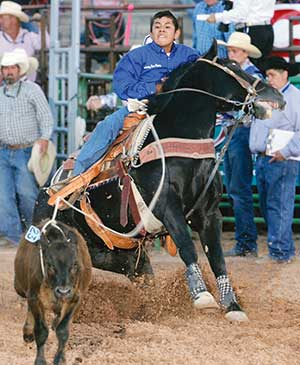

TOP: Crownpoint 8th grader Avery Jodie recorded the fourth fastest time - 2.68 - in the boys' breakaway at the National Junior High Finals at Red Rock Park. (Courtesy photo - Jennings Photography)
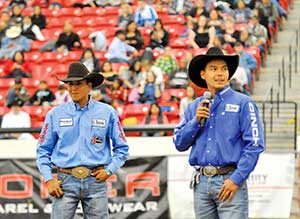
MIDDLE: Professional cowboys Derrick Begay, left, and Erich Rogers both qualified for the Wranger National Finals Rodeo in Las Vegas, Nev., in December. (Special to the Times - Donovan Quintero)
BOTTOM: Tuba City's Billy Orman sprints to the finish line of the 3,200-meter race during the Division III state track meet. Orman set a new state record of 8:48:63. (Courtesy photo - AIA/paynterpics.com)
The road was tough, but these two local cowboys went to great lengths during the 2011 rodeo season to make the Wrangler National Final Rodeo in Las Vegas, Nev., in December.
With no guarantees, Begay and Rogers put up a lot of their own money to cover expenses, such as fuel and rodeo fees, to stay near the top of the team-roping standings.
During the course of the season, both ropers experienced highs and lows, but their will and determination earn them a chance to be on center stage for 10 straight nights in what many call rodeo's biggest show.
Rogers and his partner Kory Koontz won round 7 with a time of 3.7 seconds and placed in three other rounds, winning $43,702 in his first WNFR qualification. He also won four rodeos this year including the Pikes Peak or Bust Rodeo in Colorado Springs, Colo., and the La Fiesta de los Vaqueros in Tucson.
Rogers finished 8th in the world standings and placed 12th overall at the WNFR.
Four-time qualifier Begay placed in two rounds and won 10 rodeos this year including the Round-Up rodeo in Pendleton, Ore., the Justin Boots Championships in Omaha, Neb., and was co-champion at the Treaty Day Celebration and PRCA Rodeo in Window Rock.
Begay finished 7th overall in the world standings and placed 13th overall at the WNFR.
2. Gallup Bengals coach John Lomasney passes.
Two years after retiring from Gallup High, legendary girls basketball coach John Lomasney lost his battle to brain cancer.
Lomasney, who died in April, coached both the girls and boys basketball team at Gallup High for 28 years and amassed a 503-187 career record.
But he is best known for taking the girls basketball program to new heights. A year after heading the boys basketball team, Lomasney was assigned to take over girls program and over the years the longtime coach built a dynasty by playing a patient style of basketball.
While that method frustrated many opposing coaches, it helped the program thrive with four state championships. The Lady Bengals finished on top of Class 5A in 1994, 1997 and 2002 and 2006.
3. "Buddy of the Bulls."
Karlee Tsosie, of Table Mesa, N.M., is the niece of the Tsosie brothers, the former bareback riders and founders of one of the best rough-stock contracting companies on the Navajo Nation.
But many of the reservation's rough-stock riders have dubbed her "flank girl" or "chute boss" for her role within the Tsosie Brothers Rodeo Company, owned by her two uncles Tommy and Harrison Tsosie.
Tsosie, who was 18 when the story was published in the Navajo Times, is likely the only girl on the reservation behind the chutes putting on and pulling the flank straps off the bulls. The flank strap, which is applied by the stock contractors - in this case, Karlee - is a rope that is tied around the bull's flank and encourages the bull to use its hind legs more when bucking.
She's also the one that bull riders line up to talk to to learn more about their draw.
4. NNRCA sever ties with INFR; INFR inducts first class of Hall of Famers.
A 35-year relationship between the Navajo Nation Rodeo Cowboy Association and the Indian National Finals Rodeo went sour this year after the NNRCA decided to go in a new direction.
In a vote among several gold card members in late April, the NNRCA voted to disband from the INFR and run its own show. By going independent, the NNRCA felt that they could cater to their needs by keeping funds from membership fees and rodeo fees within the association, rather than sending it up north to the INFR office.
Because of the separation, the INFR introduced the Navajo Nation Rodeo Association in May as their local affiliate.
On Nov. 12, three contestants (Benny Begay, Victor Begay and Roderick Tso) from the newly formed association were crowned world champions in Las Vegas, Nev., where the INFR unveiled its first Hall of Fame class.
The late Dean C. Jackson was one of five inductees and the only Navajo.
5. "The power of running, culture."
"Run to the East" is an 87-minute Moxie Pictures documentary that follows the experiences of three Native American runners, all products of poverty-stricken communities, and how they were able to break through a glass ceiling in the sport of running to earn scholarships to attend college.
The film was directed by New Yorkers Henry Lu and Jess Stephen. It features Zia Pueblo's Dillon Shije, and Navajo Pine High's Thomas Martinez and Chantel Hunt.
Shije was the District 4-3A champion his senior year and placed third at the state meet. Martinez helped the Navajo Pine cross-country team as the 6th man for the school's first-ever Class 2A state championship during his freshman year. He then helped defend the title all four years he was in high school.
He placed fourth at the New Mexico Class 1A-2A state meet his senior year.
As a freshman, Hunt and the Navajo Pine Lady Warriors took runner-up honors at state and took the state title her sophomore, junior and senior years. She placed third at the New Mexico Class 1A-2A state meet her senior year.
6. "Ayoo daat'iidoo."
The Tse Yi Gai varsity boys' basketball team was not a dominant team with an impressive record but one thing the players are most proud of is their ability to speak the Navajo language.
They'll instruct and encourage each other during games.
"Ayoo daat'iidoo' akoone'e' shi tsaa' yaanoldehdoo aadoo' nizhoni haaniidaa a shiizhaa' hanoolneel ayoo da'at'eeh," is how senior guard Anthony Toledo, also a co-captain, might address his team ("Try hard, even though we may lose, we should still try hard. We will do good even if we lose so keep trying hard").
Some of the boys will speak Navajo during the game and if they lose, Toledo will say something like, "Koo game binaahoolzhiish shii' nizhoni baa daaniil'kaa' koo nizhooni daaniyiil next game'ii." ("Make it better next time, focus on the next game, and look forward to making it better.")
7. "A family affair: Slowpitch softball stays strong for members of the Morris family.
For the Morris family of Mexican Springs, N.M., softball is a family affair and healing process.
Six years ago, the family lost Elvira "Dee" Morris, who was 46 at the time of her death, to renal cell carcinoma cancer. She battled the disease for 18 months before succumbing. She was an aunt, grandma, mother, sister and wife.
Over the summer, the family hosted the 5th Annual Dee Morris Memorial softball tournament to remember her.
According to her sister Bertie Becenti, 51, Morris was an avid softball player and played first and second base on various coed and women's championship softball teams, made up of her family and friends.
Two of their children - Genice, 27, and Gerald, 22 - credited their mother for introducing them to the sport.
"There's not a day that goes by that we don't miss her," said Genice.
"When we're out there we can still hear her coaching, offering us tips," Gerald said. "She was a good player herself."
Beyond winning on the field, the family still remembers the cancer that took their aunt, grandma, mother, sister and wife by honoring her through softball.
8. Trick riding sisters remember rodeo days.
They competed in just about every town west of the Mississippi River and were featured in the Western Horseman magazine, but to many they were the Grant sisters.
As youngsters Ruth Bitsui, Joy Manus and Gloria Grant-Means dazzled the rodeo community with their trick-riding skills. Younger brother Mark Grant also performed by doing vaults.
The sisters performed varying stunts, such as the strap trick, the one-foot stand and the half and full-fender drag on a galloping horse. They traveled the country and saw the world.
And although there were some risks, the sisters used trick riding to strengthen their faith and it opened a lot of doors for them.
Because of trick riding, the siblings learned self-discipline as Bitsui went on to become an accountant with Sandia National Labs while Manus and Grant-Means became school principals. Their younger brother Mark serves as the controller for the Navajo Nation government.
9. "Twin Threat: Cameron, Ariz., girls show wrestling, basketball skills in Arkansas."
Twin sisters Sheyenne and Shelby Walker moved away from rural Cameron, Ariz., in the third grade when their mother, Charlene, accepted a promotion at the Wal-Mart corporate office in Bentonville, Ark.
Since moving there, the twins molded into competitive student-athletes at Arkansas' Class 7A Bentonville High.
Sheyenne, who was one of two girls on Bentonville's wrestling team, overcame the odds of being a female wrestler and worked her way up the ranks to the varsity level her senior year. She eventually went on to sign a national letter of intent to wrestle for the Oklahoma City University's women's wrestling team, where she is currently a freshman.
While Sheyenne worked to perfect her footwork and pinning combos, her twin sister Shelby worked on her jumpers on the basketball court.
Shelby, who at the time was a starting guard and forward on the basketball team, gave up volleyball, cross country and softball to focus on basketball - a sacrifice that many athletes must make in order to match up to the competition in Class 7A.
10. "Muscles and inspiration: Bodybuilding: Quality makes up for lack of quantity."
Three brave Navajo bodybuilders - Bryan Johnson, Valerie Long, and Bobby Martin - displayed their chiseled, massive muscles when they entered the first-ever Native American Bodybuilding Competition on Aug. 24 in Chinle.
Johnson, of Rock Point, Ariz., was a normal, active young man when he came down with a strep infection that got into his bloodstream and shut down his kidneys.
After being hospitalized for nearly six weeks, Johnson, 23, overcame all odds, including the advice of his doctors, and decided to fight his infection with his will.
Once he got out of the hospital, but still on semi-weekly dialysis, he braved debilitating fatigue to start working out.
"My doctors said, 'You'll never be able to keep it up,'" he recalled, "but I was determined." Johnson won a trophy for best-developed chest.
Long, a 42-year-old mother of six and the only female body builder in the competition, said she entered the event because it's something she always wanted to do. Long also won an award for her participation.
For Martin, 41, finding out that he had 42 percent body fat was motivation to get healthier because he wants to live long enough to see his children grow into adulthood and beyond. Martin won the award for best bodybuilding body.