


Finding the heartbeat
Monument Valley High School veterinary science program unique
By Cindy Yurth
Tséyi' Bureau
KAYENTA, Oct. 8, 2010
(Times photo - Cindy Yurth)
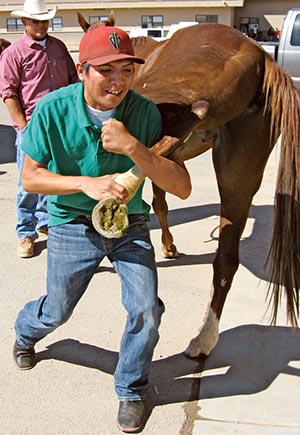
TOP: Monument Valley High School student Will Tuni has discovered he has an aptitude for equine chiropractics. Here he snaps a mare's hip joint into place during veterinary science class.
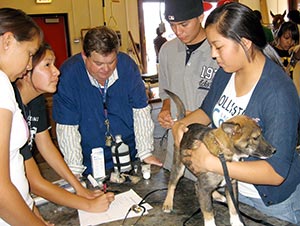
BOTTOM: Lupita the puppy appeared to have a slightly elevated body temperature when students examined her Sept. 30, so instructor Clyde McBride was consulted as to whether or not she could have her vaccines. A second temperature reading turned out normal.
For one thing, it should be hands-on.
For another, the subject should be something the students can use in their own community.
When he came to Monument Valley High School from southern Arizona in 1990, it didn't take him long to see what Kayenta needed.
Skinny stray dogs roamed the streets. Feral livestock limped along the roadside, eking out an existence on scrubby tufts of grass. Elderly sheepherders complained the nearest veterinarian was in Tuba City, and they had no way to get their animals there.
"What this town needs is a veterinary science program," McBride thought.
He bounced the idea off Joe Bahe, a Navajo veterinarian living in Crownpoint, who wholeheartedly agreed. As an agriculture teacher, McBride had evolved a lot of veterinary skills already, and Bahe suggested he attend summer sessions at Colorado State University's famed vet school to fill in the gaps.
The school district wasn't sold on the idea, however. It wasn't the usual welding, construction or animal husbandry, and the school board waited to see if it would take. McBride, meanwhile, spent hundreds of his own dollars on supplies.
After the first few years, the program skyrocketed. When McBride's students practically had to rent a trailer to haul their awards home from state and national competitions, the school board took notice.
And 20 years later, McBride's dream is taking shape here on the edge of campus: a hulking steel-frame building that will house classrooms, surgery suites with observation lofts, quarantine and anesthesia rooms - the nation's only fully functioning veterinary clinic on a high school campus.
To build it, the district forked over $2.4 million without batting an eye.
"I guess we proved ourselves," laughed McBride.
Northern Arizona Technological Institute of Vocational Education will spring for the equipment.
McBride hopes the building will be up and running by spring semester, but meanwhile, the kids are doing just fine in the metal garage that currently houses the vet sci program, which consists of a series of three classes.
Miracles large and small
On a recent Thursday, he had his advanced students divided into two teams. One team vaccinated puppies brought in by community members and the other used a small ultrasound machine to perform pregnancy tests on sheep and horses.
"Mr. McBride, I found the heartbeat!" exclaims a student as she runs the ultrasound over an ewe's uterus. On the screen, a tiny black blob pulses larger and smaller.
"You sure did!" McBride affirms.
The students gather round and a hush falls over the busy lab as they witness the miracle of a new life taking shape.
But only for a few seconds, then it's back to work filling out vaccination records and leading in the next animal.
Outside, 17-year-old Will Tuni demonstrates his specialty. Someone has brought in a sorrel mare with a limp.
Viewing her from the rear, Tuni observes one hip is three inches higher than the other. Before the mare can react, Tuni grabs her left hind hoof and hoists it over her back. An icky popping sound comes from the horse's hip. The surprised mare walks off in fine form.
"I just like horses, and I can't stand to see them in pain," shrugs Tuni, flashing a modest grin.
Like several students in the class, Iesha Atene has hopes of being a veterinarian or a vet tech.
"This is a great opportunity for us," she said. "We'll have a head start when we go to college."
Kalestinia Sullivan, 16, is poised to graduate early and enter college as either a pre-med or pre-vet student. She's already been accepted by Northern Arizona University and Arizona State University, and is waiting to hear from the University of Arizona and her top pick, the University of New Mexico.
While this A-student is no stranger to textbooks, she finds it refreshing being in a class that doesn't have one.
"To me, it means it's open-ended what you can learn in here," she said. "Mr. McBride is pretty open. If you want to learn a certain thing, he'll teach it to you."
Room for everyone
The program has its share of overachievers like Kalestinia, but McBride says there are also some special ed students.
"My students run the gamut," he says proudly. "When it's hands-on, everybody learns."
Last year, McBride was a bit taken aback to discover he had six members of a local gang in his class. They turned out to be some of his best students.
"They'd be out doing their gang stuff and they'd find a sick puppy," he said. "They'd call me and say, 'Mr. McBride, what should we do?' I said, 'You guys should start getting known for the good stuff you do instead of the bad stuff.'"
Occasionally a kid scoops up a stray on the way to school, and the class dutifully vaccinates it and treats any problems it has. So far, every one of the strays has wound up with an owner - usually one of the students.
On this day two cages in the lab house a cute puppy someone found and a tiny kitten the kids correctly diagnose as having conjunctivitis (commonly known as "pinkeye").
Locals Nick and Heidi Rice have brought in their adopted rez pups for vaccines.
"It's great for us, because it's so close and they're cheaper than a regular vet," says Heidi.
The kids charge $10 for vaccinations, which goes into a kitty for the next competition or field trip. Later this month, they've been asked to speak to students at some troubled schools in Phoenix.
McBride will head to Las Vegas to accept a national award for his invention, the banana technique of teaching sutures.
It was born out of necessity.
"I was just teaching suturing when somebody brought in a truckload of sheep that had been torn apart by dogs," the instructor explained.
McBride found a banana, split the skin, and showed the kids several ways to stitch it back up. After practicing on bananas, they spent the rest of the hour repairing sheep.
"Technically, vets are supposed to do the suturing," McBride confided. "But around here it's sometimes a matter of life and death."
The students don't do surgeries on their own, but they do assist. A couple of times a month veterinarians from Second Chance Center for Animals in Flagstaff come in to do the heavy lifting, like spays and neuters.
When the building is up, Bahe will be the veterinarian in residence, and McBride hopes to work with Charletta Begaye over at the new Kayenta Animal Care Center as well.
"We'll take as many vets working with us as we can get," he said, noting that at present the lack of hours with a veterinarian is the only thing holding his kids back from graduating as certified vet techs (after taking a competency exam).
He would love for them to walk out of high school into a $30,000-a-year job that can take them anywhere they want to go.
"They're supposed to have 1,000 hours with a vet, and we don't get anywhere near that," he said.
A number of students do go on to study veterinary technology or related fields, and McBride has arrangements with several colleges and universities. Panhandle State University in Oklahoma, for instance, waives out-of-state tuition for McBride's former students and offers them a free dorm room their first semester.
"It's about a $5,000 deal," McBride said. "We have seven studying there now."
Eventually, McBride would like to have one of his students put him out of a job.
"One day, one of them will come back and say, 'I'm a vet now, and I want to take over the program,'" McBride said. "That will be the day I retire."
 E-mail this story