


A bit of everything
35th Pueblo Grande Indian Market features 150 Native American artists
By Carmenlita Chief
Special to the Times
PHOENIX, Dec. 15, 2011
(Special to the Times - Carmenlita Chief)
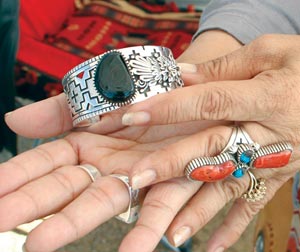
TOP TO BOTTOM: A black coral bracelet designed Tony Mitchell is displayed by his wife. The left side of the bracelet is embellished with Navajo rug designs influenced by his mother's weavings. The right side pays tribute to his late brother's vintage-style jewelry designs.
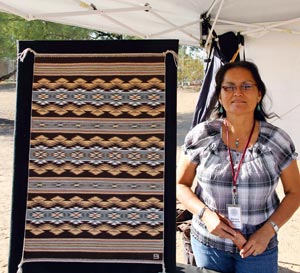
Rug weaver Geneva Scott Shabi stands beside the only item she brought for sale to the Pueblo Grande Museum market. The Wide Ruins, Ariz., resident wove the rug in the Wide Ruins style.
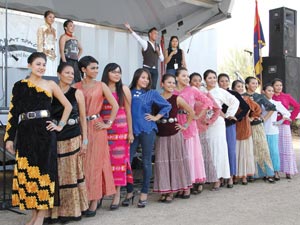
Clothes designer Shayne Watson (arm raised), 25, of Chinle, presents the models who wore creations from his line, Shayne Watson Designs. Watson was one of four young and up-and-coming Native American designers who exhibited their work at the Pueblo Grande Museum fashion show on Sunday.
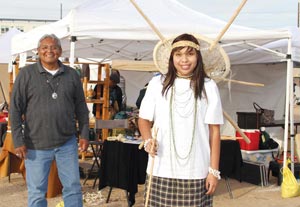
Marissa Johnson, 19, from the Salt River Pima Maricopa Indian Community, shows the appropriate way to wear a traditional burden basket (on her back) crafted by Pima/Maricopa artist Royce Manuel, left.
At the heart of the event was, of course, traditional and contemporary artwork by over 150 Native American artisans.
While Phoenix is home to the larger and more well-known Heard Museum Guild Indian Fair and Market held every March, it is also the location of the smaller but ever-popular Pueblo Grande Indian Market.
It occurs annually in December - a time when snowbirds have nested back in the Valley to enjoy the warm, wintry weather.
The auspicious timing of the market has allowed Native American artists a chance to sell and promote their work. And for the zealous art collector and admirer, it is another opportunity to purchase handcrafted gifts during the holiday season.
In years past, the location of the market skipped around the Valley from Steele Indian School Park to South Mountain Park. This year, the location returned to the grounds of the Pueblo Grande Museum at Washington and 44th Street.
Elsie Yellowhorse, from Lupton, Ariz., brought a collection of Navajo dolls, miniature pottery, jewelry and rugs to sell. She was delighted by the return of the market to the museum site.
The location provided for easier access, more parking, and hotel room-rate breaks at a nearby hotel for the participating artists, she said.
Slow economy
Many artists remarked about the impact of the slow economic climate in the lower-than-normal sales.
And for many Native families who rely on these markets to supplement their income, it is a definite concern.
"This is my livelihood we're talking about," remarked Flagstaff-based Diné silversmith Tony Mitchell.
Mitchell learned his trade from his oldest brother in 1973, shortly before his brother passed on a year later.
Mitchell has since honed a style that incorporates the "old-style" of his brother's work, the traditional teachings given to him by his grandfather, and rug-pattern designs from his mother, a weaver.
It was grandfather who advised him, "If you are going to make something that is going to be awesome, make it big so a person can see it all the way from across the street. Have them think to themselves, 'That's a piece of art!'"
When asked how the market was going for him, Pasqua Yaqui artist and performer Alex Maldonado, who was sharing booth space with his son, Nick, chuckled lightly and said, "It's been ... a lot of talking (with people)."
"We're getting a lot of 'oohs' and 'ahhs' on our stuff, but I think the economy is still affecting people, and whether they want to spend money or not," he said.
Diné weaver Geneva Scott Shabi has been weaving since she was 12 years old. Unlike most artists who had multiple examples of art on their tables, Shabi brought only one rug with her to sell - a finely woven Wide Ruins style with a price tag of $4,000.
For Shabi, who only recently started selling her rugs at Santa Fe Indian Market and at the Heard five years ago, her appearance at this market was an opportunity to promote and generate recognition for her work.
While she was not intent on making sure her rug sold, she put her faith in knowing that eventually the right customer will come along.
For each of the rugs she pours her heart and soul into, Shabi explained, "I'm always thinking, 'This rug needs to have a good home where it's going to be at next.'"
Norbert Peshlakai, an award-winning Diné artist known for his silver pots and jewelry, was selected as this year's official featured artist. Other Diné artists who have earned this distinction in the past include painter and silversmith Chester Kahn (2009) and photographer Leroy Dejolie (2003).
Fashion show
A fashion show featuring four young Native American designers and their collections was one of the highlights on Sunday.
Jackson Harris, owner and president of Sun House Alliance, an entertainment company specializing in Native American talent and events, produced the show.
First up on the runway was Noble Savage, a line created by Jeremy Arviso, Diné/Hopi/Tohono O'odham, a painter and graphic designer.
Inspired by the skateboarding and hip-hop culture, Arviso initially created T-shirt graphics in high school using spray paint. Classmates began to ask where the Phoenix-born designer purchased his shirts from and that's when he began designing shirts and other clothing items for others.
His line offers shirts, sweaters and coach jackets, among others, emblazoned with images and quotes of Native American chiefs and holy people.
Kevin Duncan, San Carlos Apache/Arikara/Hidatsa/Mandan, followed with apparel and accessories he designed for his line, Painted Warrior Designs. Fusing together Northern Plains and Southwest patterns with modern prints such as hound's-tooth and leopard, Duncan creates an intriguing look with a nod to the traditional and the contemporary, particularly with his handbags.
With the distinction of being "the only Native American to show her designs in Milan, Italy," Bonnie Woodie, Diné, from Ganado, Ariz., presented dresses from her line, BigWater Designs.
She described her designs as "a blend of contemporary and high fashion Native couture."
Woodie's grandmother, a rug weaver and "flawless seamstress," is the influence behind her sleek designs.
Culminating the show and presenting a lengthy feature of his impressive Navajo/Southwest collection was Shayne Watson from Chinle.
The 25-year-old designer has garnered several first-place awards at the annual Gallup Inter-Tribal Indian Ceremonial fine arts competition. Even at a distance from the stage, Watson's penchant for detail and superior sewing skill was evident.
Watson's designs are featured in the upcoming 2012 Women of the Navajo calendar.
Reviving tradition
Several artists were also on hand at the market to demonstrate their crafts, one of them being Royce Manuel, a member of the Salt River Pima Maricopa Indian Community near Scottsdale, Ariz., who educated market goers about the traditional bows, arrows and other woven utilitarian goods he fashioned from natural materials found in the Arizona Sonora Desert.
With a fire of determination, Manuel explained that he had taught himself the art of traditional burden-basket making through 15 years of research at museums and community archives and through conversations with O'odham community members and academic scholars.
His wife, Debbie, explained that the significance of the burden basket he had on display was crafted using a technique that had not been done in over 70 years.
The burden basket was definitely a symbol of the intensity with which Native artists are seeking to revive traditional practices and craft making. These items are not just made for display, but are given life by the artist to be used as it was in the traditional sense.