


Nizhóní Art Market offers world-class quality close to home
By Carolyn Calvin
Navajo Times
WINDOW ROCK, Sept. 25, 2010
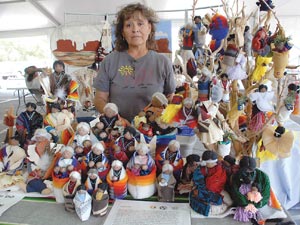
ABOVE: Sylvia C. Begaye of Fort Defiance stands behind her collection of amasani dolls at the Navajo Nation Museum's Outdoor Art Market & Blue Bird Food Festival on Sept. 17. (Times photo - Paul Natonabah)
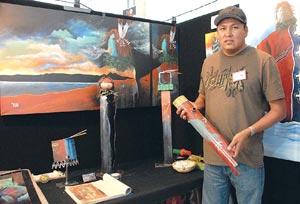
BELOW: Sculpture and painter Melvin L. John displays his work at the Navajo Nation Museum's Outdoor Art Market & Blue Bird Food Festival. (Times photo - Paul Natonabah)
Their names are well known in the art world but rarely do they have a chance to show their work at a market near home.
Artists like Ryan Singer and Anthony Emerson were among those who showed their art at the first Nizhóní Art Market held last weekend at the Navajo Nation Museum.
"The Native art industry is a billion-dollar industry and Native people have little influence in the business aspect," said Manuelito Wheeler, director of the museum. "We want to begin to show support for Native artists and have something for the community."
Wheeler said a call was put out for artists to take part in the first of what he hopes will be an annual event at the museum.
"We were looking for artists that are professional and make their living doing their art," he said. "We also were looking for up-and-coming artists and waived booth fees so that it was a well-rounded art market."
As a result, about 30 artists were on hand at the show held in a large white tent on the museum's parking lot. Attendance was sparse - not uncommon for first-time events - and organizers are hoping it will grow with time.
"This is truly a representation of traditional and contemporary artists," Wheeler said.
He singled out Ryan Singer, a Navajo artist, as exemplifying the best in marketing art work.
Singer, he said, is proof that marketing art can create a sustainable income. The artist was recently featured on the cover of the Phoenix weekly The New Times and is enjoying an increasing following.
Describing himself as a "pop artist," Singer said he focuses on surrealism, traditional portraits and sci-fi imagery. A couple of his more popular images are the wagon-burner and mutton stew in soup can.
The original painting of the wagon-burner was sold long ago but the image is reproduced on coffee mugs and on the artist's calling card. The original of the mutton stew soup can is at the Heard Museum in Phoenix.
Wheeler said a lot of time and museum finances were devoted to make this art show happen. Sponsors included the Blue Bird Flour Co. out of Cortez, Colo., and CPR, a Navajo-owned business from Las Vegas, Nev.
The show represents a major shift for many artists who are used to showing their art at off-reservation markets such as the Santa Fe Indian Market.
"We want to drive a market for Indian art on the reservation compared to markets off-reservation," said Wheeler. "One day we aspire to be one of the major art markets."
JC Black, an artist from Red Valley, Ariz., said he hopes the market will expand his exposure to local buyers.
A painter of traditional landscapes and pickups, Black's work was featured on the poster for the 22nd Annual Totah Festival in Farmington. He said an expanded local market would be extremely helpful.
As an artist, a major part of his time is devoted to travel, incurring expenses for gas, lodging and food.
"If a market is local, it's worth it," he said.
Irving Toddy, another renowned artist at the show, said, "We as the Navajo Nation need to step up and create a market for the artists."
Right now, he said, while there are hopes to make the Nizhóní Art Market comparable to the Santa Fe Indian Market, there are only two hotels in the Window Rock area.
"The Navajo government has to support business and make it easier for established artists to conduct business on-reservation," he said.
Currently there are no galleries or market opportunities, he said. Recently, he and several others formed Art of the People, a group dedicated to educating people on how "we can change the scenario."
"We can make shows like this an annual event so that people from off-reservation see where our art originates," Toddy said.
"It is possible to bring people out here to buy the art," he said. "We have Monument Valley and Canyon de Chelly."
Toddy pointed out that border towns like Gallup "know how to milk Indian art for everything it is worth."
Navajo artist Anthony Emerson, who opened his own gallery in Farmington about 12 years ago, appreciates the Nizhóní Art Market's ambition to grow but said he enjoys its "coziness and more simple atmosphere."
On the first day of the show, Emerson said he sold several "small-ticket" items he would not have been able to bring to places like the Santa Fe Indian Market due to stipulations placed upon artists. He reported that he finally sold four T-shirts that had been in his gallery for 10 years.
"You want the art show to be something enjoyable," he said.
Despite the size of the market, he added, "I've seen a couple of big-ticket items leave the show today."
Melvin L. John, a Tuba City artist and metal sculptor originally from White Cone, Ariz., said he often travels to large shows with local artists. His art focuses on traditional and contemporary depictions of ye'ii bi chei.
"I'm glad that we have the support of the museum," he said.
Surprisingly, he said, he sold a couple of pieces at the show.
Clarenda Begay, curator at the Navajo Nation Museum, said she was grateful the museum featured "artists who are on their way."
She also expressed gratitude to the Blue Bird Flour Co. for its support. As a sponsor, the company committed to buying pieces of art on behalf of the museum.
"We advertised in major art magazines to try to get the buyers here," she said. "This is the first market and we hope to get bigger and better every year."
 E-mail this story