


A man of many talents
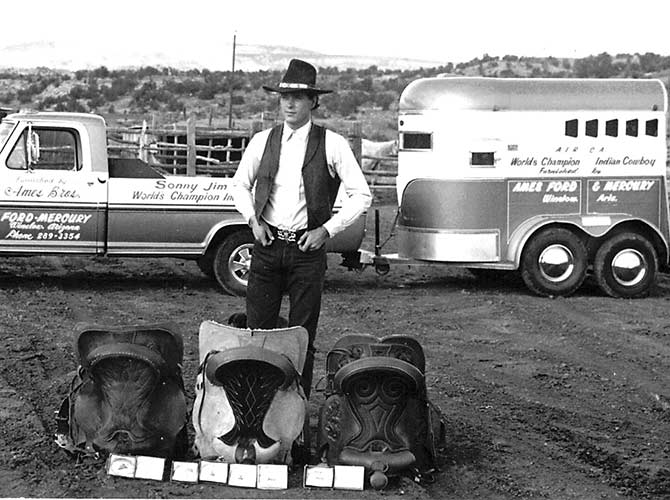
(Courtesy photo)
Rodeo cowboy Sonny Jim poses with some of his many awards won during years of competing in local rodeos on the Navajo Nation. This photo was supplied by his family.
Friends, family bid goodbye to legendary rodeo rider Sonny Jim
By Bill Donovan
Special to the Times
WINDOW ROCK, Oct. 30, 2009
Sonny Jim died as he lived, going out of his way to help a friend.
A champion rodeo cowboy, a musician, and a rancher, Jim spent his 68 years on earth continually meeting challenges and overcoming them.
He died Oct. 23 of gunshot wounds while assisting his friend Wayne Johnson on a ranch near San Rafael, N.M. (See separate story) More than a hundred family members and friends met at the Twin Lakes Chapter House Monday night to prepare his funeral and talk about Jim and the enjoyment he found riding a horse or talking about the old days in rodeo.
He was the all-around champion cowboy in 1969 and '70, among other titles he won in the world of Native American rodeo.
"He was a man of many talents," said Amos Johnson, who served as moderator at the meeting.
Besides spending almost half a century as a rodeo cowboy, Jim toured with the Harlem Globetrotters in Asia and played in the back-up bands for country music legends like Waylon Jennings and Willie Nelson.
He also was a man of conscience, participating in the American Indian Movement in the 1970s and upholding Native American traditions and cultural practices throughout his life.
Many long-time rodeo riders remember him as a role model, willing to spend time with them and advise them on how to improve their time in different events. On occasion, he even loaned friends the money for an entry fee.
Jack Jackson Sr., another long-time rodeo cowboy, said, "Everyone liked him, even those who were competing against him."
Jim's younger years were spent in Taos, N.M. His sister, Viola James, remembers that even as a young boy all he thought about was being a cowboy.
"He was always wearing chaps and carrying a rope," she said. "He was an easygoing child."
He did all right in school and excelled in subjects he liked, James said. She recalled that when Jim graduated from Taos High School, he was honored for having one of the highest grades in the ROTC program.
"He was very smart," she said. "He could do anything."
Of Modoc descent, Jim was an enrolled member of the Klamath tribes of Oregon but he decided at an early age that he would make his life among the Navajos.
Part of the reason for his choice was that the Navajo Nation had the best-organized rodeo circuit, and the biggest payouts, among the tribes of that era.
Jim had another connection to the Navajos - his family members had lived and worked at one time on the Navajo Reservation.
In fact, his parents met while living on the reservation in 1938. His mother, Lucille, was in charge of the restaurant at the old Club Building in Window Rock, which now houses the tribe's Justice Department. Jim's father, Clyde James, worked for the Bureau of Indian Affairs.
The couple married in Gallup before moving back to Oregon, where Sonny Jim was born Dec. 28, 1940, in the Klamath Indian Agency.
He was named Clyde Shacknasty "Sonny Jim" James, after his father, great-grandfather and grandfather. He chose to go by "Sonny Jim" in honor of his Modoc grandfather, said his daughter, Sonlatsa Jim-Martin.
"Shacknasty Jim" was the Anglicized name of Shkeitko, a Modoc chief who was Sonny Jim's great-grandfather.
Once he moved to the Gallup area, it didn't take Jim long to make his mark on the local rodeo circuit. While most cowboys would specialize in one or two events, Jim wanted to compete in everything and, even more remarkable, he was good at all of them.
He was the world champion Indian bareback rider in 1970 and world champion Indian steer wrestler in 1982. The 12-year span between national titles reflects another unique facet of Jim's rodeo career - he never stopped.
Most cowboys are at their peak for only a few years, but Jim would continue competing throughout his entire life, refusing to retire or join the senior rodeo circuit.
But there was another aspect about Jim's early career that made him stand out.
After competing in Navajo rodeos for a couple of years, Jim began realizing that although the Navajo-based All Indian Rodeo Cowboy Association was head-and-shoulders above rodeo organizations in other parts of Indian Country, the Navajo group had big problems that weren't being addressed by its directors.
Favoritism among judges, insufficient health coverage for injured riders, and problems making the promised payouts at some of the smaller rodeos were hurting AIRCA's reputation.
Clinton Jim, who headed AIRCA at the time, remembers the opposition within its circles when Sonny started rodeoing on Navajo land.
"Some people were saying he wasn't an Indian," said Clinton Jim, adding that the AIRCA membership committee finally required the light-complexioned Sonny to show proof that he was Native American.
It was during this time that Sonny Jim took his cause to local media, resulting in several stories airing the problems inside AIRCA. Slowly, over the next few years, the problems were resolved, in part by the formation of competing rodeo groups such as the Navajo Nation Rodeo Cowboy Association.
Jim spent a lot of his time promoting the sport and encouraging young kids to get into high school rodeo. He had a special connection with children and mentored many young people, said family members.
Kenneth Howard Jr., now a magistrate in the city of Gallup, said that among his efforts to promote rodeo, Jim helped Twin Lakes Chapter organize its annual rodeo.
Over the years, Jim competed in more than a thousand rodeos, and went home with payouts from many of them. Along the way, he was honored at a number of the rodeo events, including the Navajo Nation Fair, for his life and accomplishments.
At the International Indian Finals Rodeo held last weekend in Farmington, a moment of silence was observed in his memory.
In recollections offered Monday night at the family meeting in Twin Lakes, speakers talked about the influence Jim has had on the Indian rodeo scene. He was probably the most recognized Indian cowboy of his generation and held lifetime memberships in numerous rodeo associations.
Jim had the talent to become a world-famous professional rodeo cowboy but his heart was here, on the Navajo Nation.
"He competed in professional rodeo events but he always came back to rodeoing here," said Clinton Jim. "There'll never be another one like him." Survivors include his wife, Roberta "Bobbie" James; daughters, Sharon LaMothe, Shawna Jim-James, Sonlatsa "Sunshine" Jim-Martin, Valara Jim-James, and Tasha Jim-James; sons, Robert James, Jamie Scott and Michael Bones; sisters, Doris Hartshorn, Cheewa James and Viola James; mother-in-law, Sarah Johnson; 18 grandchildren and many adopted children.
Sonny Jim is preceded in death by his wife, Ella Johnson; parents, Clyde and Luella James; grandchild, Morgan V. Nez; and father-in-law, Tom K. Johnson Sr.
A memorial service will be held today, Oct. 29, starting at 10 a.m. in the convention center at Red Rock State Park east of Gallup. Following the service, the family will receive friends and relatives at the same location.
To make a donation towards the cost of the burial and service, call 505-713-0185 or 505-567-9347.
 E-mail this story