


Snowed in
Emergency crews try to make sure everyone is safe in wake of major snowstorm
By Noel Lyn Smith
Navajo Times
WINDOW ROCK, Jan. 28, 2010
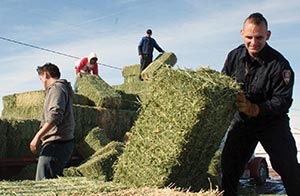
(Times photo - Erny Zah)
Ted Uhehiln of the Leupp Fire Department stacks bales of hay in Dilkon, Ariz. He was one of about 15 people who helped unload hay on Monday, Jan. 25, 2010. About 384 bales of hay were delivered.
With heavy snow accumulations hampering life in most of the Navajo Nation, Operation 2010 Snowfall is in full swing.
Incident command posts have been established in seven areas, along with command centers at chapter houses. Each location submits reports to the main emergency operations center in Window Rock, which is keeping track of assistance provided and locations that still need help.
The National Weather Service reported snow totals from last week's storm at 26 inches in Piñon Chapter, 21 at Kayenta and 19 in Window Rock. In New Mexico, Navajo got 23 inches, Toadlena received 44 and Gallup had 17.
Dogs, not lions, killing livestock
Tséyi' Bureau
WINDOW ROCK, Jan. 29, 2010
Reports of mountain lions killing livestock in the Tuba City area appear to be unfounded, a spokeswoman at the Tuba City Incident Command Post said Wednesday.
The ICP had received reports of several sheep and cattle apparently killed by mountain lions in the Preston Mesa/Tonalea area.
But Navajo Nation Rangers who investigated said they found no evidence of the big cats.
"What they did find was dog tracks," the spokeswoman said. "We believe domestic dogs killed the livestock rather than mountain lions."
At the Navajo Nation's Emergency Operations Center, incident command teams are continuing to identify high-risk populations and stranded residents while graders and dozers work to clear the main roads.
Selena Manychildren, public information officer for the center, said the priority is assisting people who are snowed in, along with the elderly, children and those with medical needs.
Throughout the week, relief personnel have been assessing remote locations to identify individuals and families who may still be trapped. Assessments are relayed back to the chapters and the chapter officials identify and prioritize the needs for their areas.
People should try to contact their chapter houses if they need assistance, Manychildren said.
With an El Niño weather system active in the Pacific Ocean this winter, more heavy snows are possible, so people should stock up on supplies if possible.
"Preparedness is the most essential thing," Manychildren said.
The public is also reminded to listen for weather reports and prepare accordingly, dress for inclement weather, weatherize vehicles, avoid traveling alone, carry some form of reliable communications, and carry matches and non-perishable food.
People are advised against going into the forest for firewood because of the unknown road conditions and the possibility of getting stuck far from help. Instead they are advised to purchase wood at retail stores or contact their chapter house, Manychildren said.
The emergency operations center has been working with the National Guard to airlift supplies to remote areas.
Personnel from Apache, Navajo and Coconino counties, the McKinley County USDA, Apache County Sheriff's Office and other agencies have been providing assistance. The Hopi Tribe is also providing help within the partitioned lands.
With many chapters facing low or depleted emergency funding, on Tuesday the Navajo Nation Council appropriated $1 million in emergency relief funds to assist the 110 chapters, according to a press release from the speaker's office.
Massive supply effort
Meanwhile, bundles of water, potatoes and other food were awaiting distribution at the emergency operations center warehouse at the Window Rock fairgrounds Tuesday.
Albert Wallace, public information officer for the Parks & Recreation Department, was overseeing the packaging of donated goods, including firewood and hay, for delivery to isolated households.
"It's back-breaking work," Wallace said.
On Tuesday a surge of volunteers was helping out at the warehouse, where Wallace and others have been working at since the weekend. The volunteers came from various divisions and departments, including the Navajo Scouts firefighters, Water Resources, Fish & Wildlife, and Library Services.
Among the volunteers was Miss Navajo Nation, Tashina Nelson, dressed in casual clothing unlike her usual public-appearance attire.
"I was trying to figure out if I should dress up, but it wouldn't have matched if I was over there tying up wood," Nelson said as she looked at a large pile of wood nearby.
Since arriving at 8 a.m., Nelson had helped bundle bags of potatoes with cases of bottled water, as well as assembling firewood into bundles.
President Joe Shirley Jr. and the council delegates discussed the weather emergency Monday during the first day of the council's winter session.
In his State of the Nation address, Shirley said he completed an aerial assessment Sunday of the Chuska Mountains, Defiance Plateau and Black Mesa, among the highest points of elevation in Dinétah.
"I visited with individuals who've been stranded for over a week in remote areas because of more than 4 feet of snow accumulation," Shirley said. "These flyover assessments are critical to the emergency relief operation because we are able to use the information to identify high priority areas and concentrate our efforts."
Shirley also reported that the Navajo Agricultural Products Industry gave more than 2,400 tons of animal feed and food such as beans, flour and potatoes at reduced prices. The company allocated $100,000 to transport the supplies.
In addition, Basha's and Lowe's supermarkets have donated food for emergency staff and volunteers working long hours at command central in Window Rock.
Delegates spoke of the local efforts being made by chapter officials and community members in their areas.
"They do put their lives at risk," said Leonard Tsosie (Pueblo Pintado/Torreon/Whitehorse Lake), praising medical care and relief efforts by the tribe's community health representatives.
Early emergency focus was on clearing main community roads through a combined effort of the tribal and BIA transportation departments. Both agencies are concentrating on main routes, including school bus routes and medical emergency access routes.
Sgt. Richard Guinn, public information officer for the Apache County Sheriff's Office, said personnel and equipment have been assisting the tribe throughout the relief effort.
Crews were in the outlying areas of Sawmill and White Clay, Ariz., on Tuesday and made assessments of 22 families. Crews were also headed to Crystal, N.M., on Wednesday to make contact with six families who have not been heard from since last week.
"As with any incident like this, the first priority is human lives," Guinn said.
"What we need is to clean all our roads," said Marlene Biltah, secretary-treasurer of Black Mesa Chapter, in a telephone interview Tuesday.
She said the chapter contacted the BIA in Chinle about clearing residents' entry roads, but was told federal regulations prevent the agency from providing service to private roads.
The chapter has received hay and has been in contact with Basha's for food donations, Biltah said. In addition, Black Mesa Community School has provided 4x4 vehicles and can also house people if conditions get worse, she said.
The chapter has been using a front-end loader to clear roads and the road grader operator has been working 10 to 12 hours a day to clear the snow, Biltah said, noting that the biggest challenge comes from snowdrifts that were created by strong winds accompanying last week's storms.
 E-mail this story