


2011 Top 10 stories
Under new system, expectations fall short
By Marley Shebala, Noel Lyn Smith, Cindy Yurth and Alastair Bitsoi
Navajo Times
WINDOW ROCK, Dec. 29, 2011
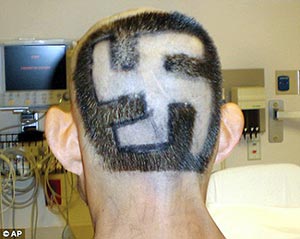


TOP: Two men pleaded guilty to a hate-crime last summer that involved shaving a swastika on the head of victim Vincent Kee. (Courtesy photo - Associated Press)
MIDDLE: Anna Marie Brown from Vanderwagon, N.M., was one of the first Navajo Nation citizens to receive the new ID card Nov. 11 at the Navajo Nation Museum in Window Rock. (Special to the Times - Donovan Quintero)
BOTTOM: Members of the Haven family hold up signs and wave flags as the funeral procession for fallen Navajo Nation Police Sgt. Darrell Curley passes July 2 on State Highway 264 at Cross Canyon, Ariz. (Special to the Times - Donovan Quintero)
The Navajo people had high expectations for government reform under the new 24-member Council but those hopes melted away with the snow as they watched and listened to the delegates niggle over new rules for choosing a speaker and other minutiae instead of approving the substantive changes to Title 2 needed to make the legislative branch function with a smaller Council.
The 24 had started working on the amendments a day after they were inaugurated and planned to approve them at the winter session in late January, but didn't get it done until April and then had only a truncated version of what they'd agreed on in their January work sessions.
The widespread hope that a smaller Council would be less costly also evaporated as the 24 approved a $1.4 million budget for assistants and field offices, often staffed with incumbents from the previous Council.
2. Navajo Police Sgt. Darrell Curley killed in the line of duty
Sgt. Darrell Curley, 48, became an unexpected victim of domestic violence when he and Officer Vernon Begay responded to a call for help in Kaibeto, Ariz., on June 25. The call was from a mother whose two sons were drunk and fighting.
As Curley and Begay were arresting the brothers, their father, Victor Bigman, fatally shot Curley four times.
On July 2, more than 300 people, including President Ben Shelly and law enforcement commanders and officers from across Arizona, paid their respects to Curley, who was remembered as a Sunday school teacher, a Mormon high priest, loving father and husband, and mentor to the young men in his community, Chinle.
Curley is survived by his wife Pauline and children Arielle, Derrick and Bronte; grandson Alex; parents, Ned Sr. and Gloria Curley; and six siblings.
3. Slush fund prosecution goes to civil court
The hunt for corrupt tribal officials took a new turn when Special Prosecutor Allan Balaran dropped criminal charges alleging misuse of more than $33 million in tribal money against 75 former and current Council members and re-filed those same allegations as civil complaints.
He also expanded the number of officials charged to 142, including all 88 members of the previous Council, former President Joe Shirley Jr., former Attorney General Louis Denetsosie, current Attorney General Harrison Tsosie, and Controller Mark Grant.
Balaran then announced that he wouldn't ask for an extension of his contract, which also included the investigation and prosecution of failed business projects OnSAT and BCDS as well as the Tribal Ranch Program.
Balaran's contract ended Sept. 30 and the Special Division of Window Rock District Court hired Rothstein, Donatelli, Hughes, Dahlstrom & Schoenburg of Santa Fe, a private law firm that successfully prosecuted former Chairman Peter MacDonald Sr.
4. Peabody pays $50 million to settle RICO lawsuit
Settlement of the Navajo Nation's $1.8 billion Racketeering Influenced and Corrupt Organizations Act lawsuit against coal giant Peabody Energy and two partners, Salt River Project and Southern California Edison, was quietly announced by Peabody in a two-page statement posted on its Web site Aug. 4.
The tribe was just as quiet in announcing the end of the largest damage suit in its history, although the $50 million settlement immediately grabbed national media attention.
Both the tribe and the defendants said the settlement ended a $600 million lawsuit, though the tribe had estimated total damages as high as $1.8 billion when it first filed the suit 12 years ago.
5. Cloud darkens over Navajo Head Start
The future of Navajo Head Start remains uncertain as of this writing, with the tribe still falling short of health and safety requirements five years after losing, then regaining, the federal money on which it is wholly dependent.
In 2006, the federal government shut down Head Start after repeated warnings to President Joe Shirley Jr. and then Vice President Ben Shelly about serious violations that involved staff and classrooms. Hundreds of workers lost their jobs and thousands of Navajo children lost their only access to preschool, a proven way to help them prepare to learn.
After years of corrective actions, expenditures, and negotiations by the tribe, many Head Start centers reopened but this time faced a new threat - competition from growing preschool programs in public schools. Navajo Head Start never regained its previous enrollment and some centers remained closed for noncompliance.
In October President Shelly announced the federal program planned to scale back funding to reflect the lower enrollment, threatening some centers with closure by Nov. 1.
Shelly later announced that he'd got the feds to back off. But in early December, after a thorough interrogation by the Council's Budget and Finance Committee, Shelly staff assistant Dawn Yazzie admitted that the tribe's Justice Department attorneys filed a restraining order against the feds to block the Nov. 1 funding cut.
That didn't stop the feds from notifying the tribe that next year's Head Start funding would be chopped in half. Yazzie also confirmed the committee's fears that Head Start's outstanding noncompliance issues, not just low enrollment, prompted the feds' threat.
6. President Ben Shelly uses line-item veto, Council outraged
On Sept. 22, Shelly used the line-item veto power given to him by Navajo voters in 2009, vetoing 16 of the Council's appropriations in the 2012 budget, primarily in the legislative branch and amounting to about $3 million.
The Council's response was swift and furious. Delegates accused Shelly of retaliating against them, especially Resources and Development Committee Chair Katherine Benally, whose committee travel budget of $130,050 was axed, along with funding of daycare and elder services that she'd transferred from Shelly's budget.
Benally said she's always fought for the elders and children and if anyone wants to take from them, they have to go through her.
"I'll take them on," she shouted in the Council chamber. "Bring it on, Mr. President!"
In early December, Budget and Finance Committee member Danny Simpson sponsored legislation for the Council to restore the travel funds, along with about $1.5 million for assistants for the 24 Council delegates, $397,000 for the office of Speaker Johnny Naize, and more than $353,000 for the Green Economy Commission.
7. Hate crime victim Vincent Kee speaks out for first time
On Aug. 18, two of three men who lured and then tortured a mentally disabled Navajo man were sentenced to years of federal prison. Vincent Kee, 22, the victim, asked after the hearing, "Why, why would they, why would they hurt me?"
On April 29, 2010, Paul Beebe, Jesse Sanford and William Hatch invited Kee to an apartment in Farmington and offered to give him "Native pride" body decorations.
Then they used a marker to write "white power" on the back of his neck and draw an obscene picture on his back.
They shaved a swastika on his head. And then they shoved a towel in his mouth to stifle his screams as they branded a swastika on his arm with a wire hanger heated on the stove.
Federal prosecutors said Kee was targeted because "he happens to be a Native American."
Kee is also a victim of fetal alcohol syndrome and is mentally challenged. His case was the first one to reach sentencing in New Mexico since the first federal hate crime act was passed in 1969.
8. President Ben Shelly vetoes partial smoking ban
On Aug. 5, Shelly vetoed the Navajo Nation Smoking Regulation Act, which banned commercial smoking in public places, with the exception of casinos.
Shelly said he was more concerned about protecting the health of infants and children than tribal casino dollars.
The Council, which supported gaming czar Bob Winter's argument that a smoking ban would drive away the big spenders, failed to override Shelly's veto, which effectively left the reservation open to smoking in public places.
Anti-smoking advocates hoped Delegate Katherine Benally would win the Council over with her anti-smoking bill but Benally unexpectedly and without explanation withdrew it in November.
The tug-of-war over a smoking ban goes back to 2008, when then President Joe Shirley Jr. vetoed the Commercial Tobacco Free Act, which would have banned cigarette smoking and tobacco chewing in all public places on the Navajo Reservation, including casinos. The Council failed to override Shirley's veto.
9. Brewing environmental battles take center stage
Three coal-burning power plants on or near the Navajo Nation - Navajo, Four Corners and San Juan - were under pressure from the U.S. Environmental Protection Agency or states to clean up their act, with industry spokesmen predicting dire consequences including the possible closure of Navajo Generating Station if it is forced to adopt the best available retrofit technology. That decision is expected this spring.
Meanwhile, the Arizona Snowbowl started building a pipeline to transport treated sewage effluent to snowmaking equipment on its ski runs. Environmentalists and Native traditionalists cried foul, noting there is still an appeal of the project in the courts.
At least 14 people, including several Diné, were arrested during protests on Dook'o'oosl’’d and in Flagstaff.
Nearby at the Grand Canyon, mining companies and environmentalists sparred over proposed new uranium leases on the canyon rim.
Interior Secretary Ken Salazar's temporary moratorium on the leases is set to expire on New Year's Eve, paving the way for renewed controversy in 2012. On a positive note, the federal government cleaned up old uranium mining sites in Crownpoint, Tuba City and Monument Valley.
10. Tribal ID cards
On Veterans Day, the Navajo Nation issued its first photo identification cards, aimed at making it easier to prove citizenship and avoid harassment under Arizona's new "papers please" law or by border agents.
The ID cards cost $17 and are the size of a driver's license, containing much of the same information - name, birth date, gender, physical characteristics, mailing address, signature, a date of issue and expiration, as well as the person's tribal enrollment number.
Tribal officials developed the photo ID as a way to prevent the production of fake Certificates of Indian Blood. Each card has enhanced security features, such as a machine-readable zone containing the cardholder's personal information that can be scanned by authorities at border checkpoints. The card can also be used to board domestic flights.
Tribal officials would like the cards to eventually replace the federal CIB. Until then the CIB remains a valid proof of tribal enrollment and U.S. citizenship.