


Desert Rock art show opens eyes
By Desiree Deschenie
Special to the Times
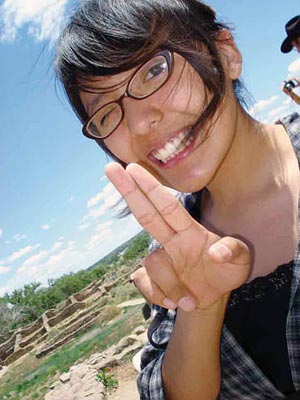
Desiree Deschenie
I can recall at least twice when a relative pointed out the highway markers for the Dooda Desert Rock campsite as we drove by on U.S. Highway 491.
My only response was to nod and resume listening to my iPod. I just was not interested.
When I entered artwork into the "Connections: Earth + Artist = A Tribute Art Show in Resistance to Desert Rock" at Fort Lewis College, I was pleased with my minimal effort at a protest of any kind, because every teenager wants to protest something.
But after viewing the other entries I realized how uninformed I have been about the proposed Desert Rock power plant. I began to think about how the present power plants have already affected the environment. But I also thought about how the proposed power plant might be helpful to the Navajo Nation by providing jobs.
The art show reception, on June 22, featured different artists' renditions of imagined possibilities if more and more Native lands are used for industrial development.
The winner of best-of-show, James Joe's painting "Bleeding Sky," depicted the most shocking scenario. His painting featured a Navajo family of four. However, besides their traditional clothing, none of them looked like the typical Diné people,
The father's skin was paper white to symbolize assimilation into the Anglo culture. The mother was very beautiful, but had to use an oxygen tank to breathe. The children were vaguely drawn, to depict their loss of individuality and voice.
There are perfectly vertical and horizontal lines that cross in the middle of the painting, signifying the belief in the balance of life. However, in the background there are "red blood lines" flowing downward, symbolizing problems that subtly grow over time. I learned these explanations from Joe's talk at the reception.
His painting captured the attitude that some feel toward the Desert Rock power plant: resistance. However, this was only one of the many pieces of work that unexpectedly affected all who saw them, me included.
After viewing all of these works, I was disturbed, angered and saddened. What made me finally realize its importance was the art, not the many attempts made by my relatives or tense speeches or literature published.
An amazing result was the possible implications this collection of artworks had the ability to explore. The art needed no explanation. It was up to each viewer to make his or her own conclusions about the creators' intentions. The works are often ambiguous, with no real definition. One can only react and reflect upon one's feelings.
In an article in the New Yorker magazine last year, Benjamin Walker talked about how art, in general, has lost its sense of "aura" because of the technological age we live in. He said that, with the use of digital cameras, the Internet, and television, art can be found anywhere with only a click.
He discussed how art used to cause a sort of pilgrimage because one had to travel to see it. When art started to be widely available, not anything special anymore, he said it lost its aura.
I did not fully understand what he meant until I went to the Desert Rock art show. There was a real sense of aura around these works. It was interesting to puzzle over what each artist thought about the Desert Rock power plant. There were many emotions behind each artist's vision. The end result is a visual contribution to a complex discussion.
One might also describe the art show as a desperate cry for help. The art show is explicitly titled "in Resistance to Desert Rock." The proposed site is situated on the Navajo Reservation near hundreds of families that have been there for decades.
The main people who would be affected are Navajos, and so why is this not a major issue among a majority of the Navajo people? After seeing all the different artwork, I feel inspired to pay more attention to the proposed Desert Rock power plant.
In my case, art made me more aware of what is happening, but it is only a starting point to help gain knowledge. I plan to continue informing myself about the developments and about what I can do to help.
If this personal statement has made anyone think twice about the impending power plant, please visit www.dooda-desert-rock.org/blog or www.myspace.com/connections_earth_artist for ways you can get involved.
For sure, go to the Fort Lewis College Southwest Studies Center in Durango, Colo., and see the exhibit for yourself: "Connections: Earth + Artist = A Tribute Art Show in Resistance to Desert Rock." It will be on display through September.
Desiree Deschenie, of Farmington, is a student at Dartmouth College.
 E-mail this story